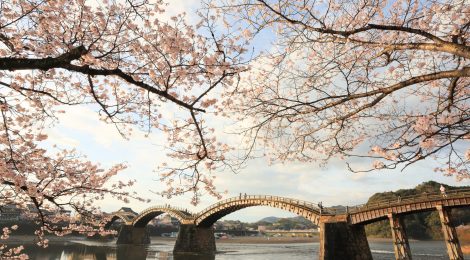
Kintaikyo Bridge Iwakuni Guide 2026: Tickets & Sights
Kintaikyo Bridge stretches over the Nishiki River in Iwakuni, Yamaguchi Prefecture, with five graceful wooden arches rising above sturdy stone piers. This is not only a picture-perfect bridge but a gateway to castle-town history, riverside walking, Kikko Park and Iwakuni Castle. The bridge dates to 1673, although the wooden structure has undergone major reconstruction after floods and repeated maintenance.
Visitors planning a day trip from Hiroshima should know the current bridge admission, the steps on its arches, the transport connection from JR Iwakuni Station and the option to purchase a combined bridge–ropeway–castle ticket.
Admission fees, opening hours and safety in 2026
- Bridge admission: ¥500 for adults, ¥250 for elementary-school children; no one-way-only ticket.
- Combined ticket: ¥1,550 adults or ¥700 children for the bridge, ropeway and Iwakuni Castle.
- Crossing: generally possible around the clock, but admission is still payable when ticket booths are unstaffed.
- Physical access: curved arches contain steep steps and can be slippery, especially in rain or snow.
- Weather: strong winds, high water or typhoons may temporarily prevent entry.
All rates above are from Iwakuni City’s official Kintaikyo admission page checked in October 2026. Avoid assuming the bridge is wheelchair accessible; the riverbank provides safer views for people unable to negotiate the timber steps.
Five arches, a flood-resistant design and a long history
The bridge is celebrated for its arched timber construction, which was intended to create a more durable river crossing. The original construction was completed in 1673, and the design became a recognized symbol of local craftsmanship. When a major flood destroyed the bridge in 1950, it was reconstructed using traditional techniques. Its survival as an architectural idea involves ongoing skilled maintenance, not an untouched original piece of timber from the seventeenth century.
Walk slowly across the arches, study the joinery from safe public areas and then step back from the river to capture the full five-span silhouette. The nearby Kikko Park connects the bridge to Iwakuni’s former samurai district and is particularly attractive during cherry blossoms and autumn foliage.
What to do after crossing
Kikko Park and the castle ropeway
The park has tree-lined paths and grounds connected with the former Iwakuni castle town. From here, a ropeway can take visitors uphill toward the castle if operating. Check the ropeway and castle opening schedules separately because a combined ticket does not override an unexpected maintenance closure.
Seasonal photography
Spring blossom season brings visitors to the riverbank; summer offers leafy views and winter can be quiet, although frost makes the bridge more hazardous. Evening illumination may operate, but the official site warns that lights are switched off by 10 p.m. Avoid climbing on railings or blocking bridge steps while photographing.
Getting here from Hiroshima and Yamaguchi
From Hiroshima travel by JR train to Iwakuni and change to a local bus for the Kintaikyo Bridge stop. Visitors arriving by Shinkansen at Shin-Iwakuni should check a different bus connection. Allow for travel time rather than assuming the bridge is next to either station. If combining western Honshu attractions, Hiroshima Peace Memorial Museum and Atomic Bomb Dome are logical Hiroshima-city stops, while Itsukushima Shrine and Miyajima Aquarium need their own ferry and scheduling arrangements.
Longer regional trips can continue toward Hagi Castle Town, Yamaguchi Daijingu Shrine or the Hiroshima Prefectural Art Museum. These are not nearby on foot and should be treated as separate travel days.
One-day Iwakuni itinerary
Arrive at the bridge in the morning and enjoy the river view before purchasing a crossing ticket. Walk into Kikko Park, enjoy lunch around the historic area and use the ropeway for the castle if weather and operating hours permit. Leave time for the return local bus and, if staying in Hiroshima, avoid planning a last-minute transfer around its evening rush.
Travelers interested in Japanese infrastructure may compare the scenery here with Shimanami Kaido’s cycle bridges, while other historic regional destinations include Hiroshima’s memorial sites and Shimonoseki’s marine museum. Choose these for another day instead of padding one Iwakuni afternoon.
To explore more of Yamaguchi Prefecture beyond Iwakuni, the historic Shokasonjuku Academy in Hagi offers insight into the region’s political history, while the coastal Motonosumi Jinja Shrine offers an entirely different landscape. Both require a separate travel day and are not adjacent to Kintaikyo Bridge.
Frequently asked questions
Can I visit Kintaikyo Bridge at night?
Yes, the official bridge instructions allow crossing outside staffed hours using the designated fare box, subject to weather and temporary closure rules.
Is it safe in rain?
The arches can be slippery, and river flooding or strong winds can close the bridge. Follow local warnings.
Is the combined ticket worthwhile?
It can save money if you intend to use both the ropeway and castle as well as cross the bridge.
Address and Google Maps directions
1 Chome Iwakuni, Iwakuni-shi, Yamaguchi-ken. Find Direction On Google Maps.
Official references
- Iwakuni City: current bridge fees and access guidance
- Iwakuni Tourism: bridge heritage and transport
Originally posted 2025-11-25 04:17:42.